
The Heavy Truck Heat Survival Guide: 9 Things That Break First When the Mercury Climbs
Intro
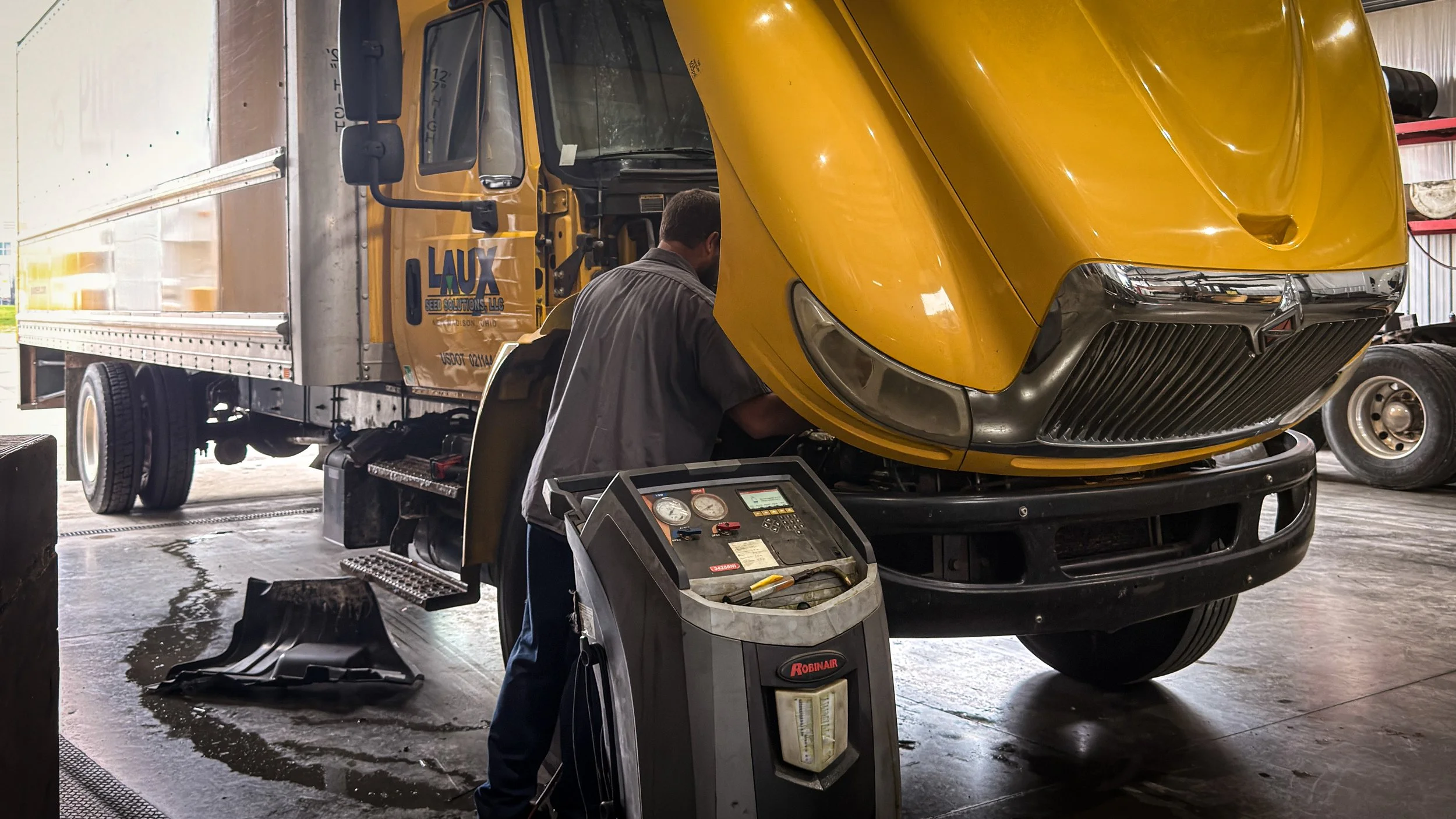
If you've worked a service bay through an Ohio July, you already know what the next 60 days look like. The first heat wave hits and the phones start ringing in a specific order — cooling complaints first, then A/C, then a couple of tire blowouts, then the truck that "just shut down on the side of I-75 and won't restart." It's the same pattern every year. The good news is that almost none of it is a surprise. Heat doesn't invent new failures. It accelerates the ones that were already waiting — a tired fan clutch that limped through spring, a coolant that lost its corrosion package three summers ago, a battery that read fine on a voltage check but never got a real load test. We see the same nine things come through our bays first when the mercury climbs, and most of them are cheap to get ahead of and expensive to ignore. Here they are, in roughly the order they show up on our schedule each summer.
1. Radiator and charge-air cooler clogging
This is the one most fleets underestimate, because it doesn't fail — it just gets quietly worse. Cottonwood, road dust, bug guts, and whatever else gets pulled through the grille at 65 mph all stack up on the fins. The radiator looks fine from the front. From the back, with a light behind it, you can see how much of the airflow is actually being blocked. Cooling capacity drops slowly enough that drivers adapt to it. They get used to running 10 degrees hotter on grades. By the time the temperature gauge actually pings them, the system is already pushing the limits. The fix is cheap if you stay on top of it. Inspect monthly through the summer. Clean with a foaming radiator cleaner and a low-pressure rinse. You can use a pressure washer — but only on a low setting, holding it back, and squared up to the fins, never raking it across them at full trigger. We've pulled too many trucks with fins folded over by a well-meaning driver and a power wand. If you want it done right, pull the charge-air cooler and clean it out of the truck — and while it's out, go ahead and pressure wash the CAC fins too, since you've already got it on the bench. If the charge-air cooler looks oily on the inside, that's a separate problem (usually a turbo seal) and it's worth catching before the cooler is full.
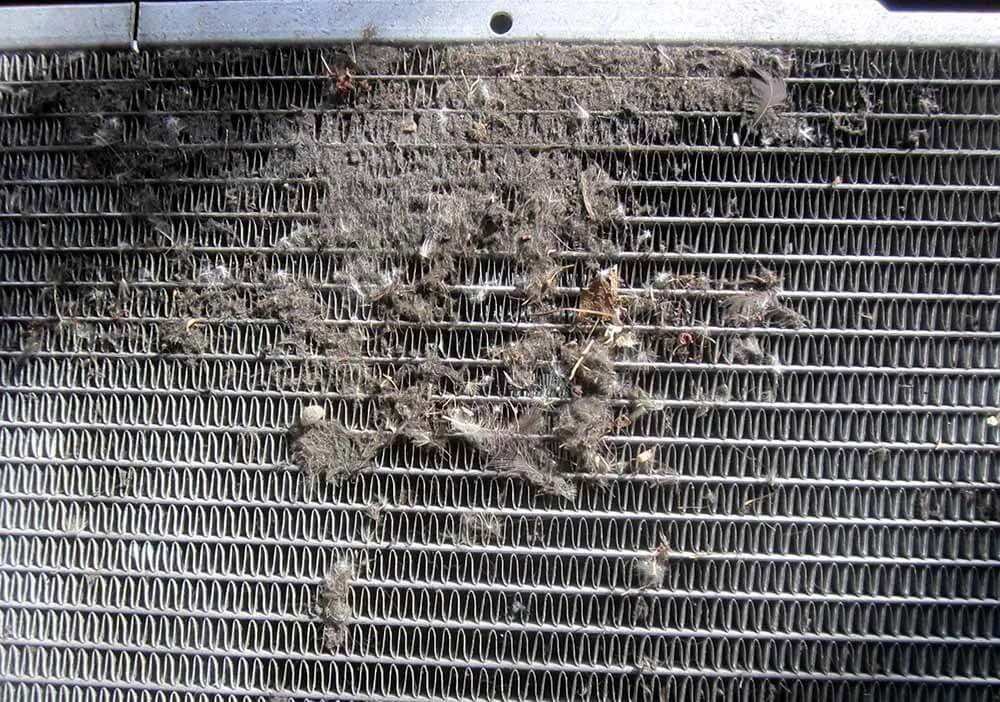
Radiator clogged by debris
2. Coolant degradation and the 50/50 myth
Coolant breaks down on a calendar, not just on miles. The supplemental additives that keep the system from corroding deplete over time whether the truck moves or not. The pH drifts. The freeze protection might still test fine while the corrosion package is gone, and a system with no corrosion protection in July is a system that's quietly pitting its water pump impeller and chewing through liner seals. The "50/50 ratio" only tells you the freeze point. It doesn't tell you whether the coolant is still doing the rest of its job. Don't chase the calendar on this — go by what the test strip says. As long as it's testing in range, run it. When the numbers start drifting out, that's your signal it's time, not the date on the invoice. What to actually do: Pull a sample at PM and run a test strip. Check pH, SCA level, and nitrite or molybdate concentration depending on your coolant type. If anything's out of range, flush and refill — and replace the supplemental coolant additives on the schedule the OEM specifies, not when the coolant turns brown. A full system service runs a few hundred dollars. A liner failure from neglected coolant chemistry runs into the five figures.
3. Fan clutch slip — when a tired Horton lets you down
When a fan clutch starts to slip, it doesn't usually fail outright. It just stops locking in fully under load. The truck runs fine on flat ground, holds temp through stop-and-go, and then starts climbing temperature on a grade and won't pull it back down. Drivers describe it as "the truck's getting hot on hills, but it's fine on the flat." That's a clutch that can't generate enough torque to drive the fan at the speed it needs when it needs it most. Two things to look for. First, pull the fan shroud and inspect the clutch lining — you're checking for cracks, glazing, or other damage to the friction surface that keeps it from locking in under load. Second, listen for air leaks. Many of these are air-actuated, and a clutch that can't hold air pressure can't hold the fan, so a hiss around the clutch or the supply line is a real lead, not background noise. That's a clutch that can't generate enough torque to drive the fan at the speed it needs when it needs it most.
4. A/C compressor seizure (and why "just adding refrigerant" is a red flag)
This one we hear all summer: "It cooled fine last year, just needs a charge." A truck's A/C system is closed. If the charge is low, refrigerant didn't evaporate — it leaked out. Topping it off without finding the leak is a short-term fix that costs you a long-term compressor.Here's why. The moment the system loses charge, the oil that's supposed to circulate with the refrigerant stops reaching the compressor, and a compressor running short on lubrication is a compressor wearing itself out. On top of that, every time the system's opened up to chase a low charge, you risk pulling moisture in — and moisture is hard on the internals over time. Run a truck a couple of seasons that way and you've turned a small leak into a compressor. We see compressors lock up in late July that would've been fine if someone had run an electronic leak test in April. Even when it's just an O-ring, you're looking at a couple hours of labor plus a recharge — call it around a $500 repair. That's real money, but it's a fraction of a compressor replacement, and it's the difference between a scheduled fix in spring and a truck down in the heat. If your fleet skips A/C service because "it cools, so it's fine," at least pull a pressure check and a UV-dye leak test on every unit before the first 90-degree week. Anything that lost a measurable amount of charge over the winter needs a leak fix, not a recharge.
5. DEF system trouble in heat (and why it's not the same as DPF)
A lot of fleet managers we talk to lump DEF and DPF problems together. They're related but very different systems, and DEF specifically gets worse in summer for a reason worth knowing. DEF (diesel exhaust fluid) is a urea-and-water solution. It's stable at normal storage temperatures. But when it's exposed to heat — direct sun on a parked truck, or extended periods near a hot exhaust — the water boils off faster than the urea, and the remaining solution starts to crystallize. Those crystals can build up at the dosing valve and the injector tip, and that's where the trouble starts. The truck throws codes. Aftertreatment efficiency drops. In bad cases, the unit derates. Same with DEF that's stored in opaque jugs left in the sun: it ages faster, and a fleet that's drawing from old, heat-damaged DEF is feeding crystals into the system on every fill. Two summer rules. Keep DEF storage out of direct sun and below 86°F if you can manage it. And if you're seeing DEF codes more than once on the same unit, get the dosing valve and injector inspected — chasing the code without cleaning the hardware just resets the clock until the next one. Our DPF and aftertreatment service page has more on the broader emissions side, but the DEF-specific work usually involves a valve cleaning or replacement that's far cheaper than a tow and a derate.
6. Tire heat — pressure, reversion, and the curbside-blowout pattern
Heat is the worst thing that happens to a tire. We're not the first ones to say it, but it's worth repeating because every July we see the same three blowout patterns on our service trucks. Underinflation is the most common. A tire 10 percent low builds 30 to 40 percent more heat at highway speeds. That extra heat softens the rubber, weakens the bond between the rubber and the steel cords, and at some point the casing comes apart. Drivers thump-test tires every morning and miss the underinflation that matters — a 10 to 20 percent low tire still thumps like a healthy one. Reversion is the technical name for what happens next. Once a tire heats past a certain temperature for any sustained period, the rubber starts to lose its bond to the steel cords. The tire doesn't heal itself. You can air it back up and it'll roll, but you've baked in a future failure. The summer pre-trip standard should change. Pressure checks daily, taken cold (before the truck has moved), with an actual gauge. TPMS is worth the investment for anyone who runs a fleet, especially in summer. And on the wheel alignment side — uneven wear is a heat amplifier. If a steer tire is feathering, you're not just shortening tire life, you're stacking the deck for a hot-weather failure. Our alignment services page covers the why.
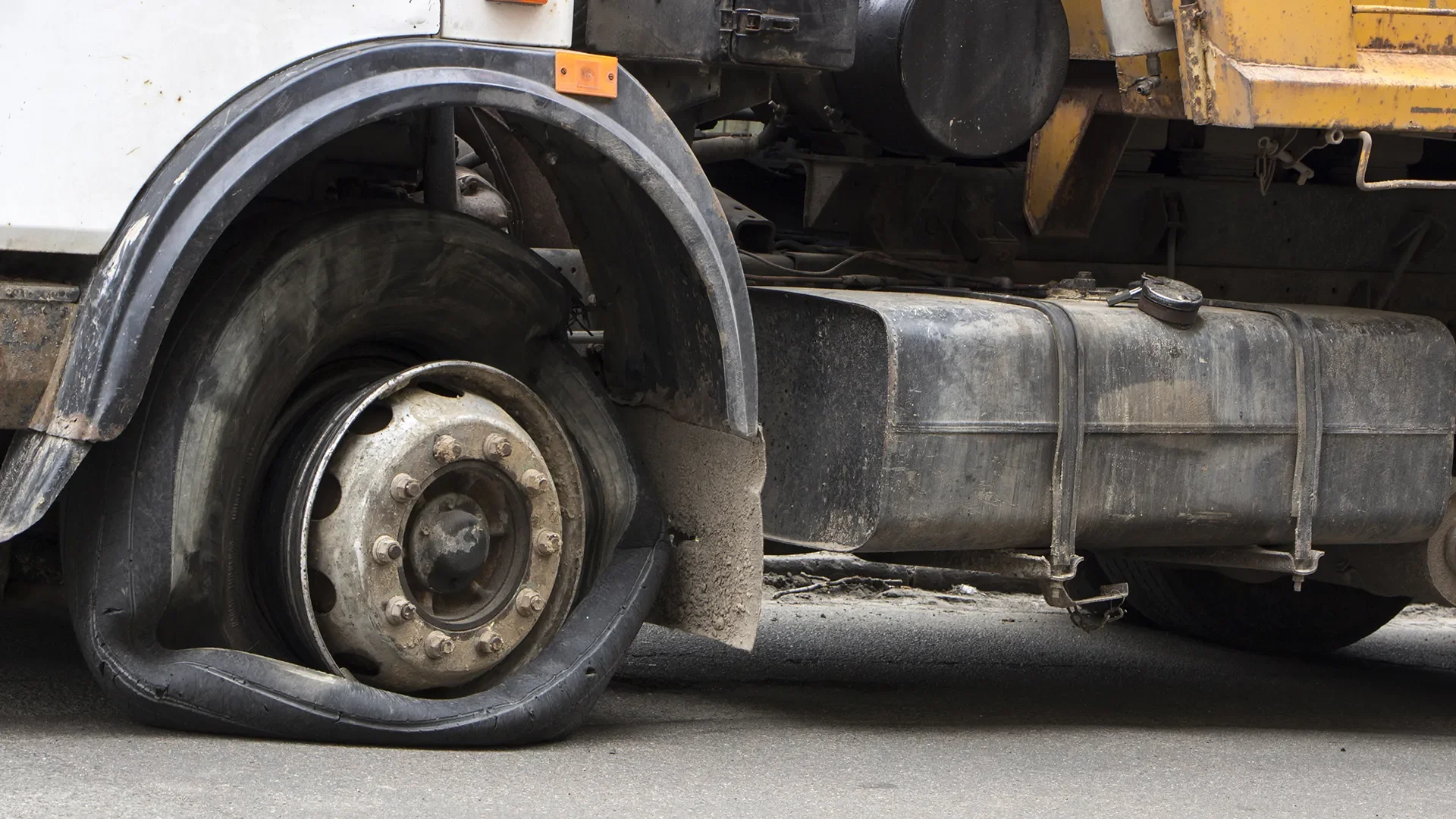
Semi-truck tire blown out due to summer heat.
7. Battery failure in heat (it's a summer problem, not a winter one)
Most drivers think of batteries as a winter concern, because winter is when a weak battery refuses to crank. But the damage that kills the battery happens in summer. Heat speeds up the chemical reactions inside a lead-acid battery. The plates corrode faster. The electrolyte evaporates. Internal resistance climbs. A battery that gets cooked in July is the battery that won't start in December. And because semi trucks usually run multiple batteries in parallel, one weak unit drags the whole bank. Three healthy batteries don't compensate for one dying one — they overwork themselves trying to. Two things to do in summer. First, load test all batteries, not just the ones that feel weak. A voltage check tells you very little; a real load test tells you whether the battery can actually deliver. Second, if you find one bad battery in a bank, replace the whole bank. A new battery paired with two-year-old ones gets pulled down to their level inside a few months. (We wrote about this in more depth in our signs your semi truck battery needs replacement post earlier this year.)
8. Idle cooling: APU vs. truck idle vs. parked A/C
This is less a failure point than a math problem most fleets haven't actually worked through.
A truck idling for an hour to keep the cab cool burns roughly one gallon of diesel and racks up DPF regeneration debt. An APU running the same hour burns about a quarter of that. Across a 10-hour rest cycle on a 90-degree night, that's the difference between roughly 10 gallons of diesel and roughly 2.5. Beyond fuel, idling stacks soot in the DPF in a way that throws active regen schedules off. Trucks that idle a lot in summer are the same trucks that show up at our shops in September with a forced regen complaint and a DPF that needs cleaning. The APU conversation is harder than it looks because the upfront cost is meaningful. Run the math, though, and most over-the-road fleets see payback inside 18 to 24 months at current diesel prices, even before you count the avoided DPF service and the better driver retention. There's a third option worth knowing about, and it's gotten a lot more common than it used to be: the electric APU. Instead of a small diesel engine, these run off a deep-cycle lithium battery bank that charges while you drive and tops off on shore power overnight. The appeal for a fleet reading this guide is simple — they burn no fuel and produce no exhaust, which means zero idling soot and nothing added to the regen debt we've been talking about all section. They're also near-silent and almost maintenance-free compared to a diesel unit. The trade-off is runtime. A good lithium system will carry HVAC through a normal 10-hour rest, but lean on it hard on a brutal night and the batteries can run down before morning, where a diesel APU just keeps going as long as it has fuel. They cost a little more up front, too. For most over-the-road fleets the math still works, especially once you count the DPF service you're not buying — but it's a real decision, not a default. If APUs aren't in the budget this year, the lower-cost play is a thorough cooling and HVAC service on every sleeper unit before peak summer — a truck whose cab cools quickly burns far less fuel keeping it cool than a truck that struggles.
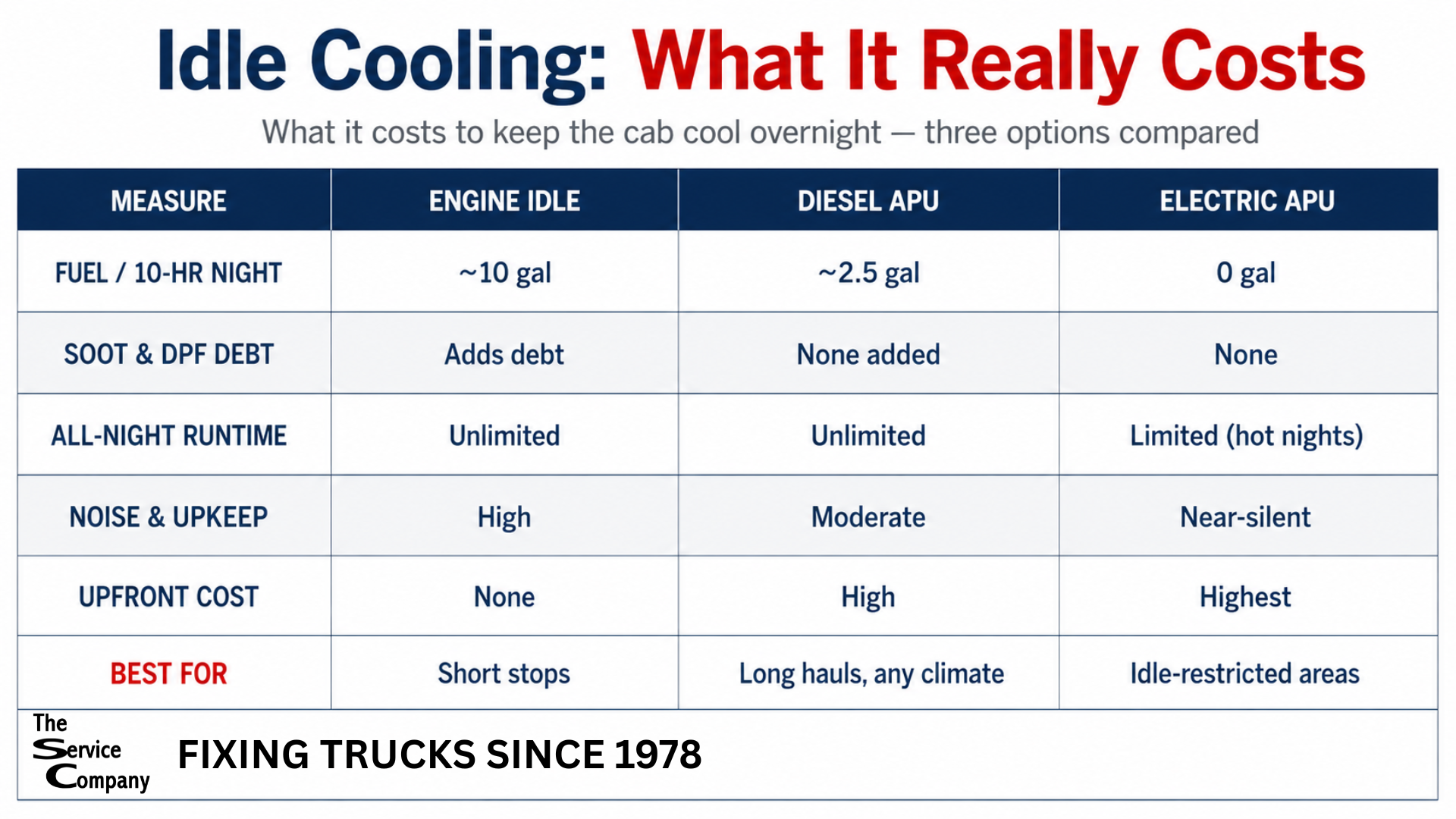
APU VS. Idle Cooling.
9. The 10-minute pre-trip add-on for July
If you do nothing else from this list, do this. Add ten minutes to every driver's morning pre-trip during July and August. Most of what kills a unit in heat shows up in a walk-around if you know what you're looking for.
The summer additions to a standard pre-trip:
Belt squeak or glaze. A belt that squeals on a cold start is dry and slipping. It won't last the day.
Hose squeeze. Pinch each upper and lower radiator hose. They should feel firm and rebound. A hose that's spongy or has a soft spot is on the way out.
Coolant cap. Check the cap gasket for cracking. A cap that doesn't hold pressure means a system that boils early.
A/C drain. Look for water dripping under the cab when the A/C is running. If it's not draining, the evaporator is freezing up or the drain is plugged.
Tire pressure, cold. Every tire, every morning, with a gauge — not a thumper. Take the reading before the truck moves.
DEF level and the ground under the doser. Check fluid level and look for any crystallization or dripping near the dosing valve. White crusty deposits are a sign of a leak you're going to chase later.
Ten minutes. Most of it can be added to the existing pre-trip without slowing a driver down meaningfully. It's the cheapest insurance in your fleet.
What it usually costs to get ahead of all of this
Across all nine of these, what we see on our shop floors is that the gap between fleets that prep for summer and fleets that don't isn't a question of capability, it's a question of timing. The work is the same; the cost is wildly different depending on when you do it.
A cooling system service in April runs a few hundred dollars and an hour of downtime. The same system after a roadside coolant boil-over runs four figures plus a tow plus a day or two off the road plus the relationship cost of a customer waiting on a load. We talk to a lot of fleet managers who already know all of this. The hard part isn't knowing; it's making the time to actually run the checks before they're urgent. The fleets who do it well usually have one of two things going for them: either a maintenance manager who blocks May and June as a dedicated PM window, or a service partner who builds the summer prep into a scheduled fleet maintenance program so it doesn't have to live on someone's to-do list. If you'd like a hand running through this list across your fleet before summer hits, that's exactly what our fleet maintenance program is built for. We can pull a unit-by-unit inspection plan together and work through it on a schedule that fits your dispatch. Or if you'd rather just stop in for a cooling or A/C check on a single unit, any of our five locations can get you in. Either way — get the cooling looked at before July. That's the one we'd put at the top of the list.
The Service Company has been keeping fleets moving across Southwest Ohio since 1978, with five service centers in Covington, Dayton, Greenville, Springfield, and Columbus. Call us at or schedule a service online.
